Skip to content
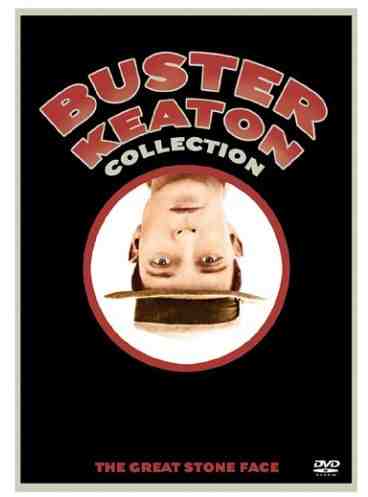
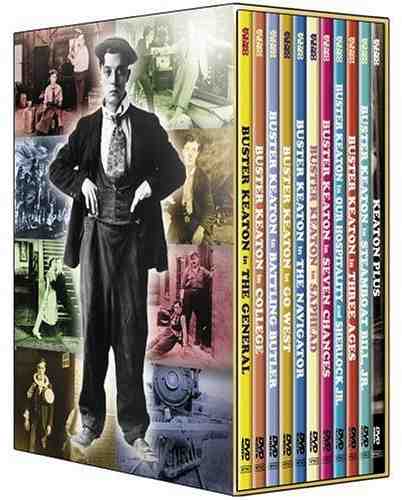
The Buster Keaton CollectionThe Buster Keaton Collection presents three of the first films (one, The Cameraman, a near masterpiece) Keaton made for MGM beginning in 1928, an arrangement that gradually ushered the great comic actor and director into the sound era but ultimately deprived him of creative control. The Cameraman, considered by many to be Keaton’s last important silent work, is an unusual story about a tintype portrait photographer (Keaton) who becomes a newsreel cameraman in order to win the heart of a secretary (Marceline Day). After flubbing an assignment by double-exposing some action footage, the hapless hero tries to prove himself in several memorable sequences of Keatonesque knockabout comedy (including a Chinatown street battle). There are also a couple of grace notes, such as a scene set in Yankee Stadium in which a solo Keaton exquisitely mimes the moves and attitudes of a pitcher. But The Cameraman’s strange, almost subconscious power is in its variation on an old Keaton refrain: The hero’s conflict over different kinds of authenticity, represented here on either side of a motion picture lens–the difference between capturing something real and living it. The Cameraman shows obvious and unfortunate signs of MGM’s insistence that Keaton, long accustomed to improvising scenes, conform to prepared shooting scripts. But it is less stifling than the second feature (Keaton’s last silent movie) in this set, the 1929 Spite Marriage, a slight farce about a pants-presser (Keaton) who borrows his customers’ fine threads to attend the theatre every night. There he worships an actress (Dorothy Sebastian) so furious with her caddish lover and co-star (Edward Earle) that she asks Keaton to marry her. The predictable results are unworthy of a Keaton film, but he does shine in several hilarious sequences, such as a disastrous turn as a bit player in his soon-to-be-wife’s stage dramas. Finally, 1930’s Free and Easy, Keaton’s talkie debut, is a garish MGM valentine to itself, trotting out celebrity actors and directors (Lionel Barrymore, Cecil B. DeMille, Fred Niblo) in a wooden story set on a movie lot. But while Keaton struggles with dialogue and a script that frequently sidelines him, he has many good moments causing havoc on film sets. –Tom Keogh Product Description of The Buster Keaton Collection A two-disc DVD collection that spotlights the actor’s MGM period. “TCM Archives: The Buster Keaton Collection” features two of Keaton’s funniest silents, “The Cameraman,” re-mastered with a new score by former Frank Zappa band member Arthur Barrow, and “Spite Marriage” (featuring its original 1929 Vitaphone musical score) along with “Free and Easy,” Keaton’s first talkie. The DVD set also features film historian Kevin Brownlow’s poignant new documentary “So Funny It Hurt: Buster Keaton and MGM.” Considered by many cinema’s greatest silent clown, Buster Keaton was a consummate practitioner of physical comedy whose career began in vaudeville at the age of three. Wearing trademark slapshoes and big baggy pants identical to his father’s, most gags involved pratfalls with his father kicking him across the stage or tossing him into the air. Within a few years of his debut, Keaton was scoring rave reviews which applauded the physical comedy that would come to be so much a part of his film fame. “The dexterity or expertness with which Joe Keaton handles ‘Buster’ is almost beyond belief of studied ‘business.’ The boy accomplishes everything attempted naturally, taking a dive into the backdrop that almost any comedy acrobat of more mature years could watch with profit” (Variety, March 12, 1910). Details of The Buster Keaton Collection Films The Cameraman – After becoming infatuated with a pretty office worker, Keaton sets out to become a newsreel cameraman in order to be closer to his dream girl. Keaton’s first film for MGM, made in 1928, is considered one of his funniest masterworks and offers up a feast of visual gags. The newly remastered DVD includes a new score by Arthur Barrow. Spite Marriage – In this 1929 silent laugh-filled classic, Keaton stars as Elmer, a man madly in love with stage star Trilbey Drew. When Trilbey’s boyfriend gets engaged to another woman, she marries Elmer in a desperate attempt to get even. This was Keaton’s final silent comedy, and is presented here with its original Vitaphone music score. Free and Easy – In Keaton’s first talkie, he stars as an agent to beauty contest winner Elvira Plunkett. When Elvira decides to try her luck in Hollywood, Elmer goes along to help and the two soon find themselves falling in love. Chaos ensues when the couple must contend with Elvira’s disapproving mother and a handsome movie star, who also has his sights set on the lovely Elvira. This 1930 classic is highlighted by guest appearances from a host of other MGM stars of the era including Robert Montgomery and Lionel Barrymore.

The Buster Keaton Collection

  • by

Editorial Review of The Buster Keaton Collection, courtesy of Amazon.com

buy-from-amazon The Buster Keaton Collection presents three of the first films (one, The Cameraman, a near masterpiece) Keaton made for MGM beginning in 1928, an arrangement that gradually ushered the great comic actor and director into the sound era but ultimately deprived him of creative control. The Cameraman, considered by many to be Keaton’s last important silent work, is an unusual story about a tintype portrait photographer (Keaton) who becomes a newsreel cameraman in order to win the heart of a secretary (Marceline Day). After flubbing an assignment by double-exposing some action footage, the hapless hero tries to prove himself in several memorable sequences of Keatonesque knockabout comedy (including a Chinatown street battle). There are also a couple of grace notes, such as a scene set in Yankee Stadium in which a solo Keaton exquisitely mimes the moves and attitudes of a pitcher. But The Cameraman’s strange, almost subconscious power is in its variation on an old Keaton refrain: The hero’s conflict over different kinds of authenticity, represented here on either side of a motion picture lens–the difference between capturing something real and living it.

Mary of Scotland (1936) starring Katherine Hepburn, Frederic March, John Carradine

Mary of Scotland 1936

  • by

Mary of Scotland (1936) starring Katherine Hepburn, Fredric March, John Carradine

Synopsis of Mary of Scotland

A historical movie, dealing with the life of Mary of Scotland. With some typical Hollywood liberties with historical fact. But with excellent performances all around.

Walt Disney's Bambi (1942)

Bambi

  • by

Product description of Bambi The forest comes alive with BAMBI, the critically acclaimed coming-of-age story that has thrilled and entertained generations of fans. Now digitally restored with state-of-the-art technology, BAMBI sparkles in this new Special Edition.… 

Angels in the Outfield (1951) starring Paul Douglas, Janet Leigh - The roughest guy you ever met until an angel said 'Hello'!

Angels in the Outfield (1951)

  • by

Angels in the Outfield (1951) starring Paul Douglas, Janet Leigh

In Angels in the Outfield, Paul Douglas, stars with Janet Leigh, as the hot-tempered Pittsburgh Pirates manager.  His hard-luck team goes on a winning streak thanks to some heavenly intervention.

Million Dollar Duck, a live action Walt Disney family comedy with Sandy Duncan and Dean Jones

Million Dollar Duck

  • by

The Million Dollar Duck (1971) starring Dean Jones, Sandy Duncan, Joe Flynn

 In The Million Dollar Duck, a lab worker (Dean Jones) takes home a laboratory animal (Charlie the duck) to prevent it from being destroyed, as a pet for his son. However, the duck’s exposure to radiation has mutated it. And it now literally lays golden eggs when the family dog barks. At first, the scientist, this ditzy wife (Sandy Duncan) think this is a Godsend. Until they begin to get greedy, and their neighbor (Joe Flynn) begins to get suspicious.

The King of Comedy - Robert Deniro - Jerry Lewis - A Martin Scorsese film - DVD

The King of Comedy

  • by

DVD review of The King of Comedy (1982), starring Jerry Lewis, Robert Deniro

Jerry Lewis as late night TV host Jerry Langford in The King of Comedy

 Jerry LewisThe King of Comedy is not the typical Jerry Lewis movie.  It’s not a comedy. It’s not for the children.  It isvery dark comedy (although rated PG). The King of Comedy looks at the behind-the-scenes life of Jerry Langford. Played straight, and brilliantly, by Jerry Lewis. He’s a talk-show host seemingly similar to Jay Leno or David Letterman.

The Ladies Man starring Jerry Lewis

The Ladies Man

  • by

Editorial Reviews of Jerry Lewis’ The Ladies Man (1961), courtesy of Amazon.com  Jerry Lewis conjured up one of his simplest concepts for this 1961 hit, but it required a lot of scaffolding. The Ladies Man puts love-scarred… 

The Disorderly Orderly (1964) starring Jerry Lewis, Susan Oliver, Karen Sharp, Del Moore

The Disorderly Orderly

  • by

The Disorderly Orderly (1964) starring Jerry LewisSusan Oliver, Karen Sharp, Del Moore, Kathleen Freeman

 In The Disorderly OrderlyJerry Lewis plays the part of Jerome Littlefield, a would-be medical student who has dropped out of school due to his extreme case of sympathy pains—whenever a patient discusses his or her symptoms, Jerome begins to feel the malady himself.  In addition, he finds himself pining for the girl that he fell in love with in college.  She doesn’t know that he exists (Susan Oliver).  To the distress of one of the nurses (Karen Sharp), who has fallen in love with Jerry Lewis’ character.

Funny Bones, starring Lee Evans, Jerry Lewis, Oliver Platt

Funny Bones

  • by

Editorial review of Funny Bones, courtesy of Amazon.com

Funny Bones, directed by Peter Chelsom (Hear My Song), is a weird but intriguing comedy with a particularly dark edge. Oliver Platt plays a would-be comedian, the son of a major comedy star (Jerry Lewis); Dad’s reputation even overshadows his son’s Las Vegas debut. After that flop the son tries to go back to his roots and heads for his father’s launch pad in Blackpool, England. There, he meets his previously unknown half-brother (Lee Evans), a bizarre comedy savant who teaches him a thing or two about taking risks to get laughs, and discovers a secret about how his father got started. Platt is likably lost and Lewis is perfectly overbearing, but the real find here is Evans, a rubber-faced, protean comic with always-surprising material. –Marshall Fine

My Friend Irma Goes West (1950), starring Dean Martin, Jerry Lewis, Marie Wilson, Diana Lynn

My Friend Irma Goes West

  • by

My Friend Irma Goes West (1950), starring Dean Martin, Jerry Lewis, Marie Wilson, Diana Lynn

buy-from-amazon The team of Martin & Lewis (Dean Martin and Jerry Lewis, of course) return to the screen in the sequel to their first film, My Friend Irma.This time, the ditzy blonde Irma (Marie Wilson) leads her roommate Jane Stacy (played by Diana Lynn), Jane’s fiancee Steve (Dean Martin), and her own boyfriend Seymour (Jerry Lewis) out west to try and break into the movies.  There’s a kidnapping plot, but the highlights of the film are Martin and Lewis recreating bits of their nightclub act, such as The Vagabond Song.

Verified by MonsterInsights